By Dr Maria Harwood
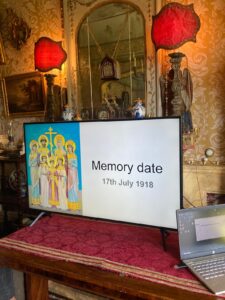
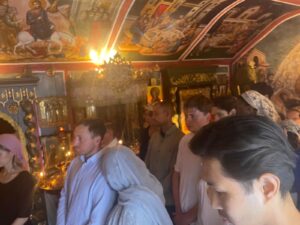
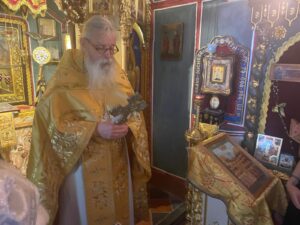
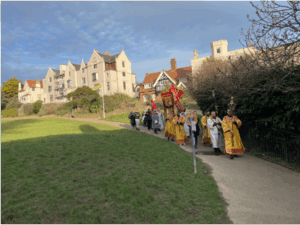
This year the Grand Duchess Elizabeth Romanov Society’s Garden Party took place on Saturday 12th July and coincided with the Feast of the Holy Apostles Peter and Paul. The memory of the Royal martyrs and Passion-bearers was celebrated just few days before the day of their martyrdom and the church feast. The Chief Apostles, who died as Holy Martyrs, met in our prayers with the last anointed Tsar-Martyr of Russia and his family, all of them executed by ungodly rulers: the Apostles – by the barbaric Emperor Nero, the Royal Martyrs and eleven other members of the Romanov family, together with their servants and attendants – by Lenin and his crew. The first tyrant was not afraid to announce his actions, the second did everything possible to hide the crime, to deceive the Russian people and the whole world by publishing false news about escapes of the members of the family, killing them in secret, hiding the bodies… Some of them, such as Grand Duke Michael and his English secretary Johnson, still are not found, nor are the bodies of the Romanovs executed in the St Peter and Paul fortress in St Petersburg. This is another link between the Romanovs and the Apostles.
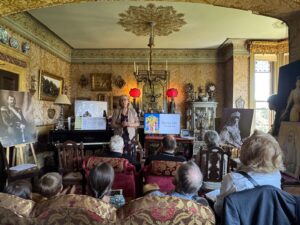
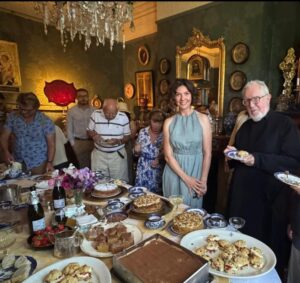
After our morning Orthodox Liturgy in the church of the All-Merciful Saviour, Father Aleksandr invited the parishioners and members of the Society into his residence, a remarkable Victorian house authentically decorated in style of 1880s.The main part of the programme for this day was a historical play about the last days of the Romanov Family at Ekaterinburg, presented by its author (one of four co-authors) Natalia Rubtsova. Natalia has had a most incredible career. She started her education and working life as a lawyer, while being attracted by theatre from her childhood. In the 90s she entered an acting school in Moscow (Shchukin Theatrical College), later she began her career as a playwright. Now she is finishing her Masters dissertation at UCL entitled “The Female Question in Female Drama of the Silver Age”. Two of her plays, dedicated to the last Imperial family, were accepted by professional theatres. One of them was successfully staged in Moscow Tsaritsino theatre, for young audiences, and presents the four Tsar’s daughters on the day before their execution. Another one shows the Imperial family during their lifetime and explores the theme of an ideal family.
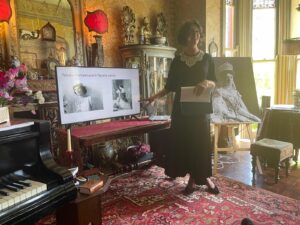
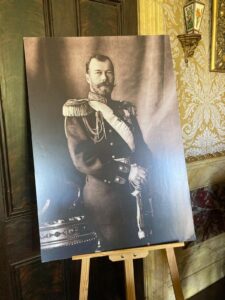
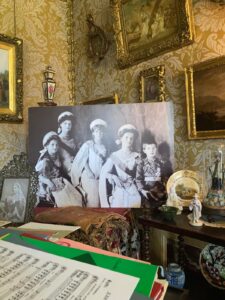
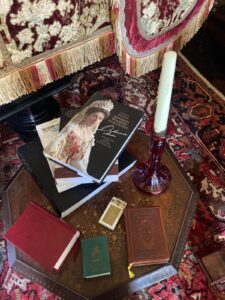
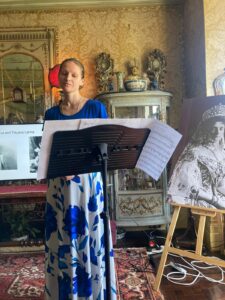
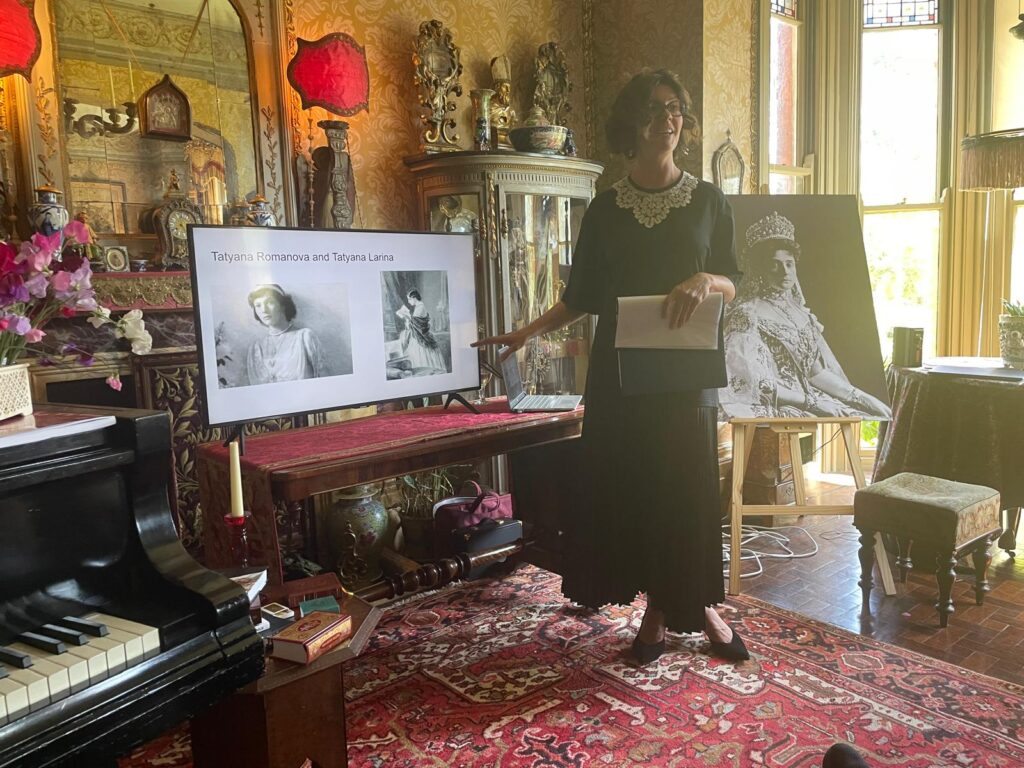
Natalia presented the first play in the interior of a Victorian house, a natural and most suitable stage setting. She chose this setting consciously because it reminded her of the palatial environment of Romanov dwellings of the past. It resembled the Ipatiev house, as well, as both houses were built in the 1880s. This resemblance was made use of by Natalia in the direction of her own performance. But how was it possible to channel the imagination of the audience from the beautiful rooms filled with icons and other antiques towards the reality of the empty and abandoned family house of the engineer Ipatiev? Three large and striking black and white portraits of the Emperor Nicholas, Empress Alexandra and their children, from the collection of the Society, looked like windows on the past. The darkness background and white sparkling figures, almost flying in the air! Natalia’s black and white dress and a candle on a small table – all these details in combination with a quiet and deep voice of the actress, did the trick: the surroundings disappeared and the walls lost their rich decorations.
In contrast, the colourful portrait of Grand Duchess Elizabeth (a copy of the famous Kulbach one) told of warm feelings and memories of a peaceful life. The icon of Saint Elizabeth was a manifestation of her unity with the Imperial Family in Martyrdom. As we know, she was killed in Alapaevsk on the next day. Other icons and religious objects, books and a grand piano – all served to make the audience immerse themselves in a historic drama, or rather in a tragedy similar to ancient classical tragedies when nothing can avoid the imminent fatal ending. One essential difference – the execution of the Imperial Family was a victory over death, and this explains why we celebrate this, a Christian martyrdom of the innocents.
The first part of the presentation was an introduction in which Natalia spoke about her play, disclosing some secrets of theatrical creative process and about her own approach to the personality of Grand Duchess Tatiana, the second daughter of the Tsar. The monologues of the four sisters were conceived as their internal monologues on the day before their execution, during the last day of their lives, and are the source of dramatic tension and a crossing point where cruel history is reflected in the souls of the innocent girls with their dreams and hopes. The monologue of Tatiana, written and brilliantly performed by Natalia Rubtsova herself, is based on a sound knowledge of the personality of her heroine, her deep faith, her compassion, her love for her parents and responsibility towards her younger siblings. She is recollecting some events from the war, she and her sister Olga’s nursing work in a hospital, some funny stories which show the characters of her sister and her father. These little stories open to the audience a wider world and change the mood and atmosphere. But they also make the return to the present increasingly tragic. The audience “remembers” it is witnessing the last hours of a young life, which will be suddenly and cruelly ended by ungodly and dark forces. All these dramatic counterpoints are implemented in the text of the play by the author, and it opens many opportunities for the directors and actors.
In the beginning, Natalia, acting as Tatiana, goes to the grand piano and plays a well known romance based on words of Alexander Pushkin, her favourite poet. It is about love but not a very happy love. This song immediately brings us into the atmosphere of 19th century Russia, and uncovers the kind, loving and artistic character of Tatiana. Her monologue easily brings up associations with the monologues of Pushkin’s Tatiana, the heroine of “Eugene Onegin”. Grand Duchess Tatiana shares some qualities with her, and this closeness of two characters, skilfully shown by the author, adds depth and life to the character of the Tsar’s daughter and makes us more and more compassionate with this young girl who is approaching her martyrdom.
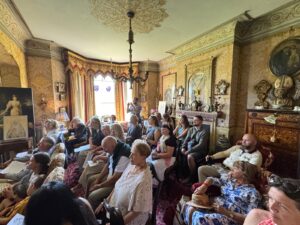
Ancient tragedy had the aim of bringing the public to the state of catharsis, which meant purification of mind through compassion and tears. This effect definitely was present in our audience. Some people could not hide their tears… Great success!
The event ended with beautiful singing of Anna Orlova, who offered to us more romances based on Russian poetry. We enjoyed Turgenev’s “Foggy Morning” and Rachmaninov’s “It feels Good in Here”. The performance was concluded by a prayer based on Psalm 141. This was a second stage of the catharsis and it resulted in calm and clear feelings that the tragedy is over.
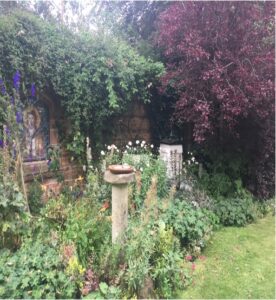
After delicious teas and cakes (made by Father Aleksandr and Natalia Rubtsova) we all could rest in the beautiful Victorian garden, where our guests found a small temple, dedicated to the All-Merciful Saviour, and a model of a new bigger church, which will become a reality if the community raises enough funds. (Please send your donations to the Rev. S.J.A.Groves: sort code 60-10-15 account 62141147, NatWest bank) see our Facebook page https://www.facebook.com/share/p/1Ato9rS215/?mibextid=wwXIfr
The Society is grateful to everybody who attended this unforgettable afternoon Garden Party, our members’ yearly event in July, organised especially for those who have subscribed to the membership (just for £2.50 a month, or £30 a year). We express our special gratitude to Natalia Rubtsova and Anna Orlova, to Alyona Kozhevnikova, who translated the monologue into English, to Father Aleksandr, our host and a musician, the trustees, John Harwood, Paul Oxborrow, Marina Shchirskaya and Anna Scriven, our parishioners Matthew Craddock, Taisia and Irina. Especial thank-you to the Head of the public group “Culture above Frontiers” Ludmila Larkina. See her publications about our church and events: https://m.facebook.com/groups/1707774252653411/posts/9961514147279339/
Please address your enquiries about the membership of GDERS to:
Treasurer Anna Scriven: Anna.scriven@yahoo.com
Chairman Maria Harwood: nd2315@gmail.com
Visit our website: https://gdelizabeth-society.co.uk/